






LGC (the globally recognised testing laboratory behind Informed Sport) is a world-renowned sports doping control and research supplement testing lab, with over 55 years of experience of regulatory analysis. With over 400 published scientific papers and over 500 man-years of research into doping control, LGC is a supplement testing lab that is recognised as a global leader and trusted partner in the field of anti-doping and supplement analysis.
LGC has been testing supplements and ingredients on behalf of reputable manufacturers and suppliers for more than 15 years. During this time, tens of thousands of samples have been tested and a number of research studies have been conducted; such studies exploring the prevalence of prohibited substance contamination within supplement products.
To understand the risks which elite athletes face, LGC has conducted administration studies, which have been published in peer-reviewed scientific journals. These studies have highlighted that consuming even microgram quantities of a prohibited substance (millionths of a gram) could give rise to a positive doping violation. LGC has also published white papers highlighting research on supplement contamination.
The field of anti-doping is continually changing, with new and emerging threats/risks continuing to challenge the supplement industry and anti-doping community. To address these challenges, LGC is continuously developing and evolving screening methodology, with ongoing method development and research programmes conducted by our specialist supplement testing labs in the UK and US. To provide assurance to brands and consumers alike, LGC routinely screens supplement products for in excess of 250 compounds considered prohibited in sport/harmful to health - substances such as drugs of abuse, anabolic agents, stimulants, beta-2 agonists, diuretics and new and emerging threats.
Test methods used for analysis of supplement products/ingredients are accredited to ISO 17025, a globally recognised standard relating to laboratories and test procedures - LGC has held accreditation since 2003. To achieve such accreditation, LGC utilises state of the art supplement testing labs and conducts extensive validation analysis to assess matrix, compound and detection performance, before adding any substances to its core screening programmes. Within the UK (LGC Fordham), accreditation is granted by UKAS (the United Kingdom Accreditation Service - laboratory number 1187). Within the US (LGC Lexington), accreditation is granted by A2LA (the American Association for Laboratory Accreditation - certificate no. 3244.01).
As a doping control and supplement testing lab, LGC works directly with sports authorities, national anti-doping organisations and national governing bodies worldwide. Providing advice and expert support, LGC is able to represent the views of partners and assist in the shaping of future regulation.
Informed Sport tests sports certified supplement products for a wide range of banned substances on the WADA Prohibited List, as well as lists for organisations such as the AFL, NRL, NFL, NCAA, UFC and MLB.
DOWNLOAD OUR CERTIFICATION PROCESS GUIDE
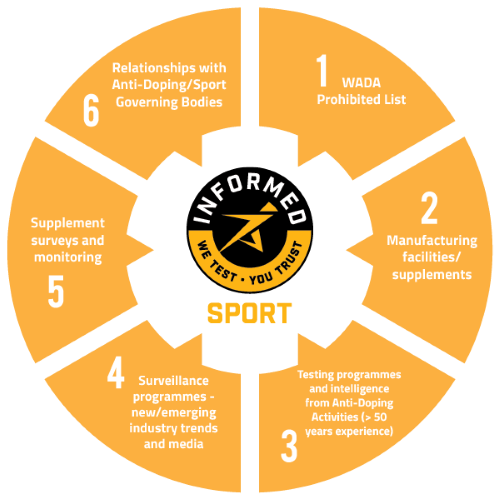
Over the last 15 years, LGC has shaped its screening programme for Informed Sport by conducting surveillance analysis and research in order to assess supplement contamination and the emergence of new threats within the supplement industry. LGC works closely with a number of key stakeholders within the anti-doping community and sports supplements industry, to ensure that screening programmes remain at the forefront of risk management.
|
LGC currently tests over 22,000 samples each year for in excess of 250 substances that are prohibited in sport and/or considered a risk in relation to supplement contamination. Screening procedures include, but are not limited to, compounds such as anabolic agents, stimulants, narcotics, beta-2 agonists, diuretics and new and evolving threats such as vaptans and PPAR's etc.
LGC is continuously reviewing and developing its testing methodology to ensure new and emerging threats within the supplements industry are addressed - this often includes the surveillance and investigation of suspicious compounds before their prohibited status is confirmed by the wider anti-doping community.
